

It is true that digital goods are increasing rapidly. But in 2026, success will not come from just having the best product.
Rather, it will come from providing the best shopping experience because that’s where expectations are rising the fastest.
Buyers now expect three things by default:
- Personalization: offers that match their needs, region and context;
- Hassle-free shopping: fast payment, minimum number of steps and mobile flows.
- Confidence: clear prices, secure payments and transparent policies.
These expectations appear everywhere. Mobile commerce continues to dominate how people shop, and digital media’s share of total media revenue continues to grow.
At the same time, fraud and phishing have increased customer caution, while privacy concerns keep pressure on how data is collected and used. In other words, buyers are moving faster, target also vote more.
And then AI adds another layer. Discovery is no longer limited to search engines and social sources.
Artificial intelligence tools are increasingly shaping what shoppers see, compare and trust. When a referral is generated in seconds, marketers have less time to convince and more responsibility to be instantly clear, trustworthy and easy to buy from.
So for digital goods marketers, the question of 2026 is not how to increase demand, but rather beyond how to reduce friction at every stage while increasing trust across markets, payment preferences, tax rules and subscription models.
In this article, we’ll break down the 2026 buyer’s journey step by step, then look at the trends shaping it and the capabilities marketers need to win.
Key Stages of the Digital Buyer Journey 2026
Buyers of digital goods today are going through a more compressed journey than ever before.
Discovery happens quickly, evaluation happens much earlier, and purchase decisions are often made before a customer even gets to a traditional product page.
To make sense of this shift, it helps to break down the journey into six clear phases, starting with how demand is created in an AI-driven world and ending with how merchants retain customers through sign-up, billing performance and lifecycle optimization.
A useful way to read this path is to treat it as s system audit. Every internship has one job: to reduce confusion, effort, or risk. When one stage fails, the next has to work twice as hard, and this usually translates into lower conversions, higher refunds, or higher attrition.
The goal is not to perfect every detail. It’s about removing a few friction points that customers will immediately notice.
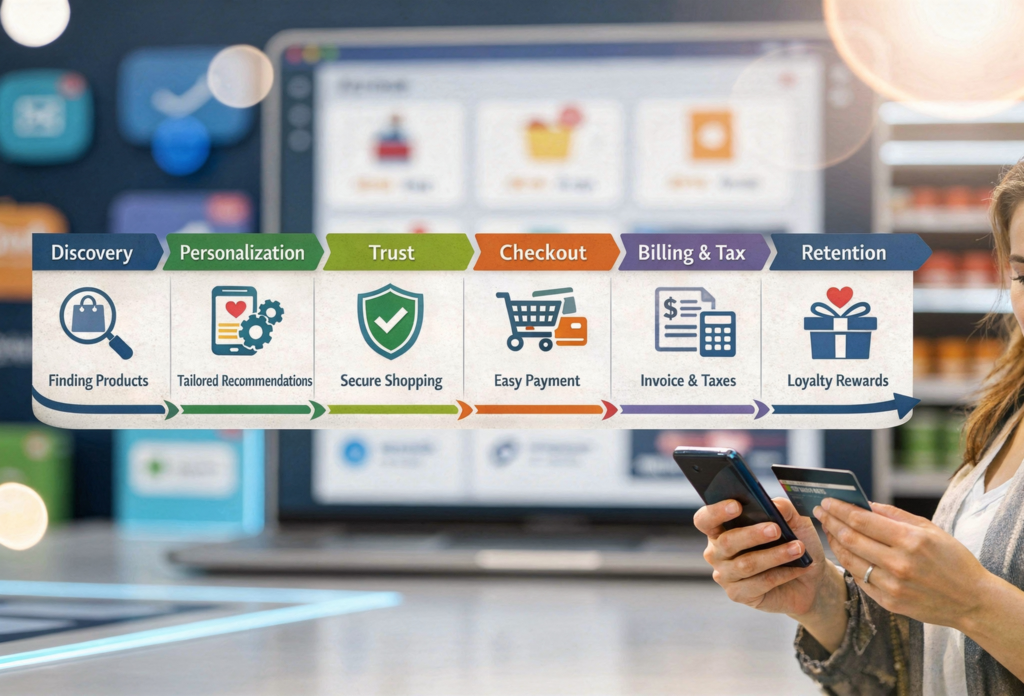
Phase 1: Problem recognition in an AI-First environment
In 2026, recognizing a problem often starts before a buyer gets to your website. Instead of typing in keyword searches, they ask AI tools, follow recommendations, or discover a need through a smart device.
Statista Consumer Insights shows that this behavior is already real: about one in five US consumers used AI platforms to find products while shopping in the past 12 months, with 24% adopting it among 18-39 year olds versus 18% among 40-64 year olds.
Statista also reports that 20% of consumers surveyed said AI tools are a part of their daily lives.
For marketers, this changes the first task of marketing: it’s not just about raising awareness, it’s about making AI easy to understand and recommend.
So if your product information is unclear, such as messy naming, missing details, confusing third parties, AI has less reason to detect you.
Here is important structured product information.
For digital goods, this means clear names and categories, clear plan and entitlement details, and packaging that’s easy to compare:
- third party,
- bundles,
- accessories,
- renewal terms.
In other words, as agentic AI grows, clarity becomes even more important.
Phase 2: Hyper-personalized product discovery
As mentioned earlier, discovery is now less about search and more about showing up with AI search layers, personalized feeds and influencers. This is changing what merchandising looks like for digital goods.
To keep up, merchants need flexible product catalogs that can support real-world variation: different tiers, add-ons, and versions built for different types of buyers.
They also need localized pricing that reflects the local currency and market expectations. And they need packages that can be dynamically displayed so that the offer the buyer sees can be adjusted based on context: what they’re already using, what they’re trying to solve, and where they’re buying from.
Personalization also joins smaller, specialized subscriptions. For example, micro-subscriptions are becoming a meaningful part of the mix. According to Deloitte’s 2023 Consumer Review, 38% of Millennials and Generation Z had at least one dedicated subscription, often under $10 per month.

Phase 3: Trust assessment and social proof
When it comes to trust signals, the ones that immediately reduce doubt are often the strongest:
Today, fraud is part of everyday decision-making. Statista reports show how rapidly attack patterns have changed: phishing has grown from 12.5% (2017) to 53.2% (2022) of reported cyberattacks by type.
Another report puts the global cost of fraud at $1.03 trillion in 2024, with average losses per victim reaching $3,520 in the US alone.
This is where trading platforms can help traders gain trust faster. 2Checkout, for example, emphasizes secure transactions and compliance support as part of its digital commerce offering, including PCI-related controls and risk management.
Stage 4: Experience the carriage without friction or failure
The basket is still where revenue is won or lost. But in 2026, the tolerance for friction is lower because more are shopping on mobile.
Therefore, one-click and biometric-style flows are becoming the benchmark. While the merchant cannot control biometrics at the device level, they can can control the environment that matters: fewer fields, fewer redirects and a checkout that works purely on mobile.
Three requests come up again and again:
- Local payment methods and digital wallets. If the buyer cannot pay as they are used to, conversions will drop, especially in cross-border markets. Statista estimates that digital wallets will grow from 50% of e-commerce payments in 2023 to 61% by 2027.
- Eligible for subscription Digital goods often include renewals, trials, upgrades and add-ons. Checkout must clearly set these expectations and support recurring billing without additional friction.
- Mobile first speed and distribution. The cart must load quickly, look clean, and keep the buyer focused on completion.
Meeting these requirements is what separates an average checkout from a high-converting checkout.
Phase 5: Billing, tax and compliance transparency
Selling digital goods across borders is getting harder, not because demand is slowing, but because the rules are constantly changing.
Country-specific VAT, GST and digital tax requirements continue to evolve and obligations expand across multiple regions. What used to be a financial task now manifests itself in the shopping experience.
At the same time, buyers expect clarity up front. They want the actual total price, the currency they will be charged in, and if it’s a subscription, what happens when they renew.
If the tax appears late, if the currency changes, or if the billing terms are unclear, it raises doubts at the time of purchase.
This is why more digital retailers are moving to a merchant of record approach: it centralizes tax and compliance responsibility and reduces the operational burden of selling across multiple markets.
For merchants, the goal is not more paperwork, but rather a cleaner path to global growth with fewer compliance surprises and billing that remains consistent across regions. 2The cashier supports this model as a Merchant of Record.
Phase 6: After-purchase care and retention
With digital goods, what happens after purchase is part of the product. Get access to delivery, registration, renewals and support whether the customer expands or cancels.
This is where subscription businesses protect revenue: not only through acquisition, but also by running the subscription lifecycle well:
Failed payments are a common trigger for loss. The faster you refund the payment, the less likely the customer will cancel the order for reasons that have nothing to do with your product.

Macro trends shaping the shopping journey to 2026
Usage pricing becomes normal
Buyers want a subscription that’s worth it. This often means smaller, targeted plans for specific needs or clear packages that make the value easy to see.
In B2B, the same shift is manifesting as more usage-based pricing, hybrid plans and add-ons, so customers can start small and expand only when they need to.
AI-powered shopping moves from ‘search help’ to ‘buy help’
AI changes the first half of the journey.
People use artificial intelligence to narrow down choices, compare options, and get recommendations faster.
The next step is purchase automation: renewals, upgrades and even assistant-triggered “go buy this” actions. This means that merchants have less time to explain what they are selling, so offers need to be more understandable at a glance: clear packaging, clear terms and clear differences between third parties.
The rules are getting tighter and privacy expectations are higher
Privacy is no longer a secondary issue. It affects how you do business, how you build trust and how you sell across borders. Buyers want to know their data is being handled responsibly, and regulators are raising the bar on what “responsibility” means.
In Europe, GDPR keeps the pressure on how customer data is collected, stored and used. The European Digital Services Act is another sign that the rules around digital services are getting tighter.
In the United States, privacy laws are also expanding from state to state.
The bottom line is simple: marketers cannot create growth plans dependent on unlimited tracking. They need to gain consent, be clear about data usage, and design acquisition and payment flows that still convert, even when targeting and measurement are less predictable.
Mobile-First is now the default
As mentioned, mobile is where many shoppers experience the entire journey, from discovery to checkout.
This raises the bar at every stage: fewer steps, faster pages, familiar payment options and prices that are clear without additional clicks.

Final thoughts
The buyer’s journey in 2026 will reward marketers who treat business as a system, not a bunch of tools.
AI-driven discovery, mobile-first payments, increasing fraud and stricter regulations all point to the same requirement: your experience must be fast and clear for customers, while remaining in control and meeting your demands.
This is why the advantage in 2026 will not come from adding more point solutions; it will come from bringing together parts like payments, taxes, fraud protection, subscriptions and localization so that every stage of the journey works together.
2Checkout is built for this kind of end-to-end execution. With global payments reach, merchant-of-record tax and compliance support, fraud protection, and subscription tools on a single platform, merchants can scale digital sales across markets without growth becoming operational complexity.